Test a Search Center before launch
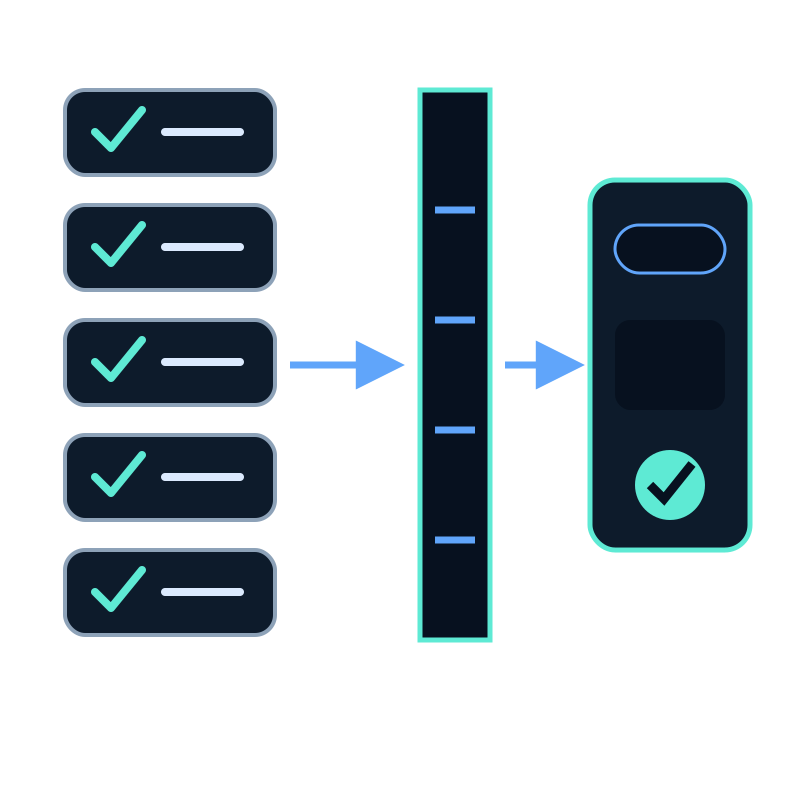
A Search Center is ready when its intended audience can open it, complete representative searches, verify the sources, and recover from unsupported questions. A polished answer to one demo query is not a release test.
Define expected evidence
Create a test sheet before opening the page.
| Test type | Example | Record before testing |
|---|---|---|
| Direct fact | One documented limit | Expected value and source |
| Multi-source task | A question spanning setup and security | Every required source |
| Vocabulary mismatch | Visitor wording differs from the docs | Intended document |
| Unsupported request | Account-specific or undocumented question | Expected limitation |
| Changed fact | A recently updated controlled page | New value and source |
Test the initial page
Check the title, description, logo, placeholder, and suggestion chips. Every suggestion should produce an answer you have already verified.
Start a second private-browser visit. When Remember previous searches between visits is off, it should begin from a clean state.
Inspect answers and documents separately
For each query:
- compare the answer with the approved fact;
- check that conditions and exceptions remain intact;
- inspect every document card;
- open the expected source; and
- locate the supporting passage.
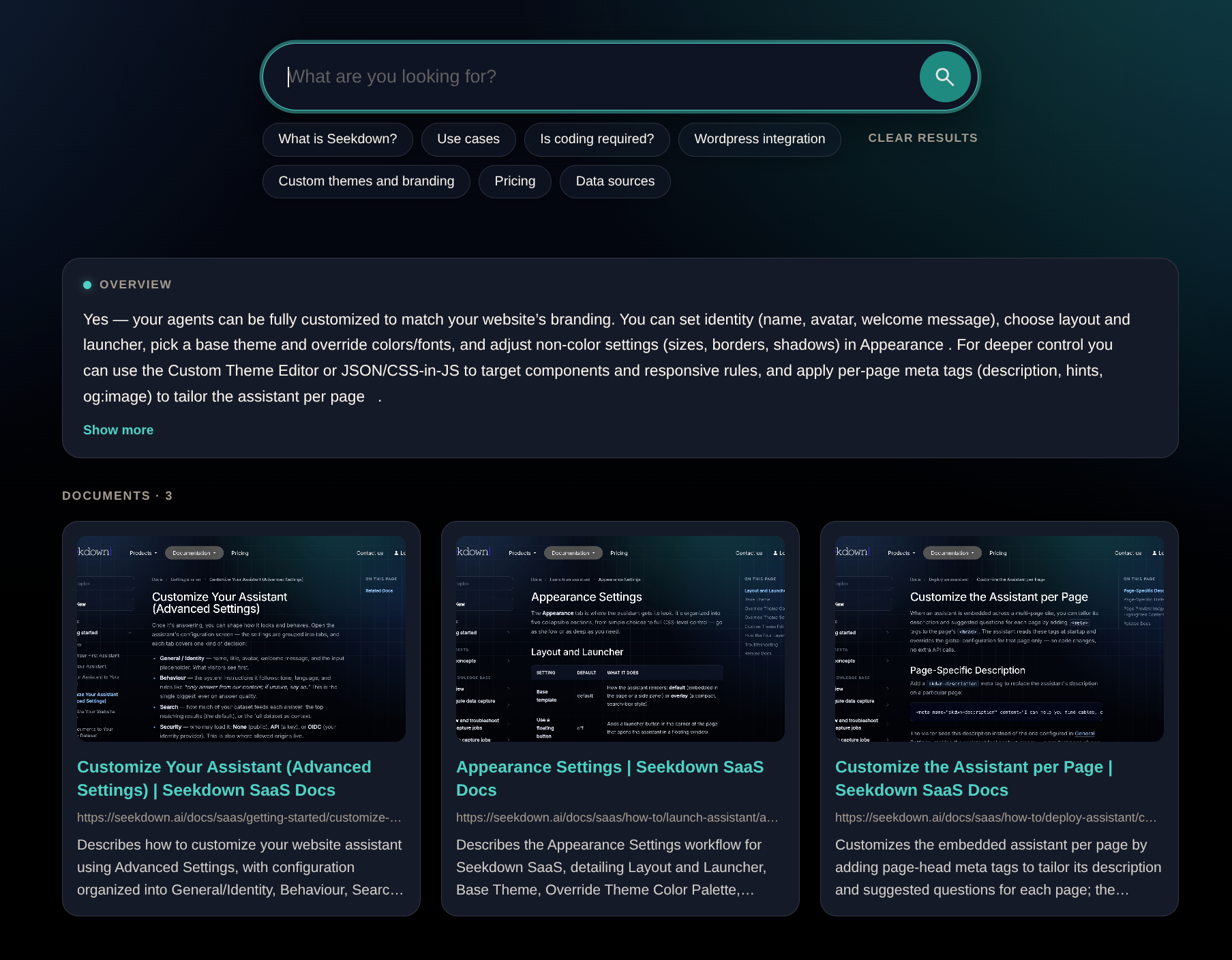
A correct sentence linked to an unrelated page still fails the citation test.
Test access and deployment
For a public page, open the hosted link without a dashboard session. For a private embed, test an approved origin with valid authentication, the same origin without authentication, and an unlisted origin.
If the page is embedded, check runtime errors and source links in the deployed environment.
Test narrow screens
Repeat a search at mobile width. Confirm the field, suggestions, overview, expanded answer, and source cards remain readable and operable.
Set the release gate
Do not publish until the team can show:
- an approved dataset scope;
- passing common and unsupported questions;
- useful citations;
- correct public or private access;
- a working hosted page or embed;
- a content-refresh owner and cadence; and
- a saved regression question set.
Record failures by stage: source, capture, retrieval, answer, citation, security, or layout. That classification tells the team what to fix.